
Stamping and Forming Technology
From stamping through forming to the coated assembly
Copper places special demands on the stamping process: the soft, ductile material tends to form burrs and requires sharp, precisely adjusted tools. On our eccentric presses with 400 to 5000 kN (40 to 500 tons) of press force, we master this challenge with routine ease – for clean cut edges and minimal contact resistance.
For electrically conductive components, cut-edge quality counts twice over: low-burr edges reduce transition resistance and extend the service life of the contact surface. At the same time, precise stamping cuts the effort needed for reworking – and at sufficiently high annual volumes, stamping is clearly more economical than CNC milling, because CNC single-part machining is slow and costly, whereas a progressive compound tool performs several operations simultaneously per stroke.
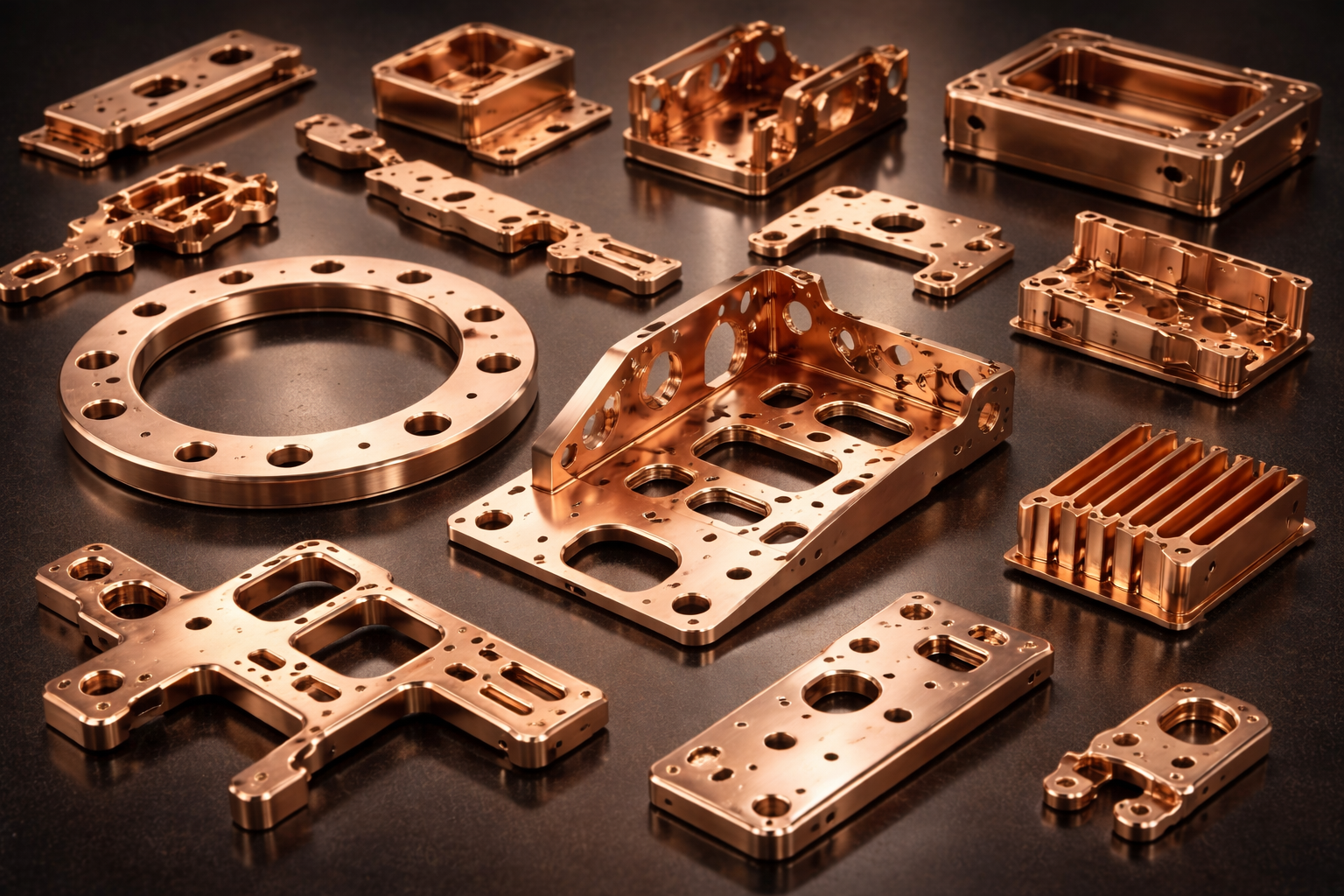
Choosing the right material determines conductivity, machinability and downstream processes
ETP copper (Cu-ETP) offers one of the highest electrical conductivities of all engineering metals and is the standard material for busbars, busbar systems and high-performance contacts. For welded or brazed assemblies, we recommend Cu-OF or Cu-DHP instead, since the residual oxygen in Cu-ETP can be problematic with these processes.
Cu-OF is the choice for vacuum applications and welded constructions. Its electrical conductivity is practically on a par with Cu-ETP, but without the risk of hydrogen embrittlement during welding or brazing.
Cu-DHP contains phosphorus for deoxidation – ideal for soldered or welded copper assemblies. For pure current-carrying tasks, however, Cu-ETP and Cu-OF offer the better conductivity values.
Brass (CuZn37, CuZn39Pb3) combines strength, machinability and formability – typical for spring contacts, connectors and plain bearings. Thanks to its lead content, CuZn39Pb3 is especially easy to machine, ideal for combined stamping-turning operations with threads.
Not sure which alloy suits your application? Send us your drawing with a description of requirements – we'll suggest the technically and economically appropriate material.
Copper stamping isn't your core business? We take over complete relocations involving several hundred tools. From tool transfer to a stable series ramp-up, we manage the whole process.
Copper lends itself superbly to forming. Bending, embossing and deep drawing are part of our standard repertoire – including complex contact geometries and spring contacts.
Through our partner network we arrange tin plating, silver plating and nickel plating. The right coating improves solderability, contact resistance or corrosion protection.
We don't just supply individual parts: on request we assemble units with integrated copper contacts – ready to install in your production.
Where Evotec copper stampings are used
Busbars, busbar systems, terminals, contacts for switchgear and power distributors. In e-mobility we supply stamped copper parts for battery module interconnection, HV connectors and charging infrastructure – wherever high currents must be transmitted with low resistance losses.
Commutator segments, collectors, brush holders and interconnection parts for electric motors and generators. The combination of conductivity, dimensional stability and mechanical strength makes copper stampings the standard material in drive technology.
Copper is at home in heat exchangers, evaporators and piping systems. We supply stamped copper parts for heat exchanger fins, distributors, heat sinks and sealing elements – wherever thermal conductivity and corrosion resistance are required at the same time.
Grounding components, sliding contacts, control cabinet busbars and EMC shielding. Our copper and brass stampings are used in machine tools, automation technology and process plants – often as part of ready-to-install assemblies.
Our workflow for your copper stamping production
You send us your drawing (PDF, DXF, STEP) or a sample by email. We assess feasibility, advise on the right copper alloy and prepare a detailed quote – usually promptly.
For tool design we work with long-standing, specialized partners. Progressive compound tools up to 3,000 kg are possible. Before series start, we produce initial samples for your approval. On request, we prepare an initial sample inspection report to VDA standard.
Series production runs to documented inspection plans with in-process controls. Through our partner network we arrange downstream tin plating, silver plating or nickel plating – integrated directly into our production workflow. If needed, we store your tools and maintain safety stock.
Send us your requirements – we'll be glad to advise you on your copper stampings.